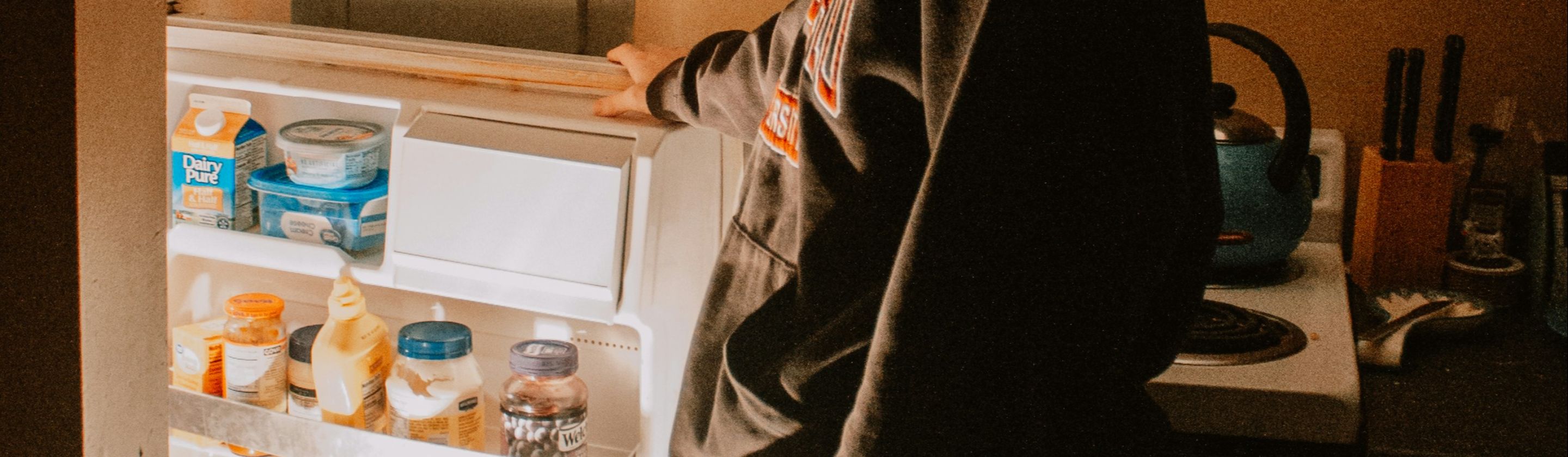

Almost everyone has stood in a friend's kitchen, opened the fridge for something to drink, and ended up doing a quiet inventory of everything on the shelves. Nobody teaches this behavior directly, yet it happens the same way in nearly every kitchen you've ever visited. The scan takes about two seconds, and somehow it still leaves an impression that lasts far longer than that.
What makes this stranger is how differently we treat the fridge compared to the rest of a house. Wandering into someone's bathroom uninvited feels like a real violation, while glancing at the contents of a living room bookshelf barely registers as anything at all. The fridge sits in an odd middle zone, open enough to peek into casually, private enough that doing so still feels a little charged. Most of us never stop to ask why a stretch of shelving inside an appliance carries that much social weight, yet somehow the door barely closes before an opinion has already formed.
Why The Fridge Feels More Private Than The Rest Of The House
Part of the answer comes down to what a fridge actually holds. A bookshelf displays taste on purpose, curated for anyone who happens to look. A fridge holds what someone actually eats when nobody is watching, which makes it closer to a diary than a display case.
Anthropologist Mary Douglas wrote about how households organize objects into categories of clean and dirty, proper and improper, as a way of maintaining a sense of order. A fridge sits right at the edge of that boundary, since it stores things meant to be consumed but also things left too long, forgotten, or slightly embarrassing. Looking inside means seeing both sides of that line at once.
That combination is why a stranger casually opening your fridge can feel more invasive than someone flipping through your phone gallery for a few seconds. A gallery shows curated moments. A fridge shows leftovers you forgot to throw out and the same three condiments everyone seems to own, along with whatever habit you'd rather keep to yourself.
What You're Actually Doing When You Peek
The scan itself happens almost involuntarily, closer to pattern recognition than conscious judgment. Within a couple of seconds, most people register whether the fridge looks organized or chaotic, full or nearly empty, stocked with vegetables or dominated by condiments and takeout containers.
None of this gets said out loud, but it forms an impression anyway. A fridge full of prepped meals and labeled containers reads as a certain kind of person, while one with three sauces and a lone tub of hummus reads as a different kind entirely. Neither impression is fair, and both form within seconds regardless.
Market research firms have long tracked grocery habits by household type, and surveys from groups like the USDA's Economic Research Service consistently show that fridge contents vary enormously by income, family size, and region. A quick glance obviously can't capture any of that context, yet the glance still happens, and the impression still forms before anyone stops to consider the full picture. A single parent's fridge and a college roommate situation's fridge can end up looking remarkably similar for completely different reasons, though a two-second scan rarely leaves room for that kind of nuance.
The Etiquette Nobody Wrote Down But Everyone Follows
Most people follow a version of the same rules without ever discussing them. Ask before opening someone's fridge unless you've been told to help yourself. Take only what you were offered, and resist the urge to rearrange anything, even when the disorganization is genuinely bothering you.
Commenting out loud breaks the unwritten agreement fastest. Pointing out an expired carton or a suspiciously empty produce drawer turns a quick glance into an evaluation, and evaluations are exactly what this whole ritual is supposed to avoid. Close friends and family get more leeway here, since familiarity tends to lower the emotional stakes of an open fridge door.
The whole exchange works because everyone agrees to look without really commenting, and to notice without saying anything about what got noticed. That small, quiet agreement says something about how people manage privacy in shared spaces generally, granting access without turning that access into judgment out loud, even when a judgment was clearly made the moment the door swung open. It's a strange little social contract for something as ordinary as a kitchen appliance, and yet almost nobody breaks it, which might be the clearest sign of how seriously we actually take it.